From October 2026, two separate legal duties around harassment are changing and the gap between knowing this and being able to evidence it is where businesses get exposed.
The standard for preventing sexual harassment rises to ALL reasonable steps (up from just “reasonable steps”). And employers become directly liable for harassment by third parties (customers, clients, contractors) across all protected characteristics.
If you can’t demonstrate that you took all reasonable steps to prevent harassment, under either duty, your business carries the risk.
Our HR People carries out harassment prevention reviews and will tell you precisely what needs fixing, so you can lead with confidence.
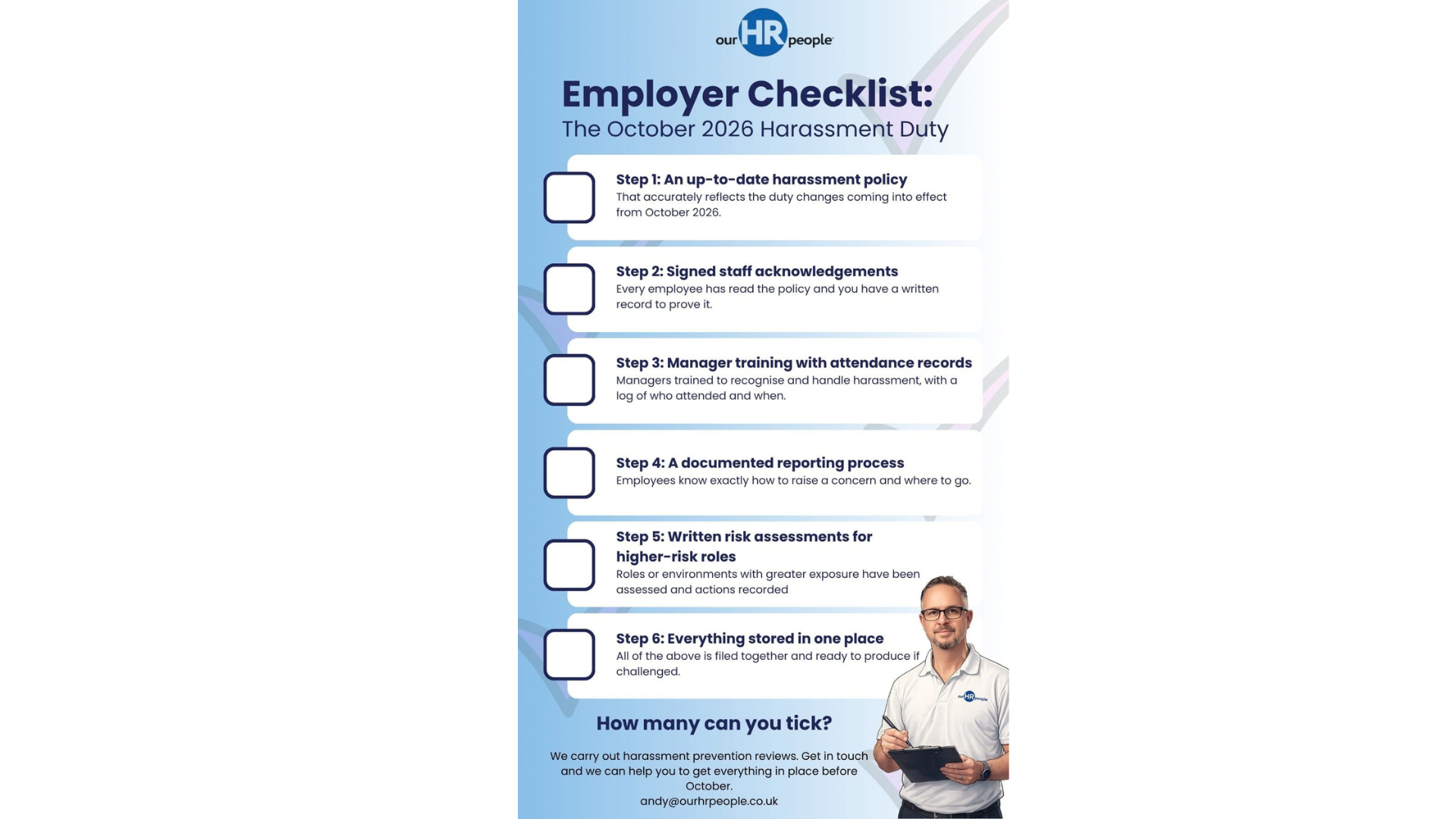
We’ve distilled the key requirements into a 6-step checklist so you can see exactly where you stand as a leader.
If you can’t tick off all 6, let’s talk before October:
☐ Step 1: An up-to-date harassment policy
That accurately reflects the duty changes coming into effect from October 2026.
☐ Step 2: Signed staff acknowledgements
Everyone has read the policy and you have a written record to prove it.
☐ Step 3: Manager training with attendance records
Managers trained to recognise and handle harassment, with a log of who attended and when.
☐ Step 4: A documented reporting process
Employees know exactly how to raise a concern and where to go.
☐ Step 5: Written risk assessments for higher-risk roles
Roles or environments with greater exposure have been assessed and actions recorded.
☐ Step 6: Everything stored in one place
All of the above is filed together and ready to produce if challenged.
How many can you tick?